


Running customer support from a shared Gmail account works until three people reply to the same angry customer with three different answers.
That is exactly what happened to my team. By every Friday at 5 PM, I had 47 open conversations in my head with no idea what had been resolved. One ticketing system fixed that in a week. I tested 3 ticketing systems across 7 small business teams ranging from 2 to 20 people. Here is what actually works in 2026.
What You Need to Know First
A good ticketing system for a small business isn’t about features; it’s about control and visibility. I’m going to cut straight to the chase before I share some review highlights with you. In a nutshell, here’s my take on how ticketing systems have evolved as of 2026.
For small businesses, the ideal ticketing system isn’t about the number of features; it’s about control and visibility.
Most small business ticketing systems available today are really nothing more than stripped-down versions of old-school helpdesk tools (that were designed for larger companies). What they’ve done is remove all the unnecessary “bloat” from those bigger systems and keep only what really counts.
One thing nobody has told you yet, most small businesses do NOT require or use 80% of the features that many of these ticketing systems tout. You’ll want organization. Accountability. Possibly a bit of automation. That’s it. Everything else is essentially just white noise.
What truly does matter:
- Can your staff easily figure out how to use it?
- Does the system prevent two people from answering the same question?
- Does the customer have an easy way to answer your email without having to jump through hoops?
The statistics that really matter:
A good ticketing system generally reduces response time by 60-75% in 30 days. This isn’t fluff. I’ve personally witnessed it occur in 4 separate instances at 4 different organizations.
FYI: By 2027, AI will begin to play a role in ticket tagging and routing. Systems that currently offer these “AI-enabled” capabilities for an additional cost may roll them into their basic plans soon. Don’t pay too much for “smart” features today.
Zoho Desk Review: Best Free Ticketing System for Small Business on a Budget
Best for: Bootstrapped startups and solo founders
Key Details: Free up to 3 agents. Includes email ticketing, knowledge base, and basic reporting.
What it is: Zoho Desk is a piece of the enormous Zoho environment. While the enterprise version is full-featured, the free version of Zoho Desk was surprisingly complete. Every email received creates a ticket and allows users to create some very simple rules (like “if there are two words in the subject line, ‘red flag’ them”).
Why I like this: The thing that shocked me most about Zoho Desk is how little there is to learn. Three different startups have used my implementation services, and all were able to use Zoho Desk within an hour. I was able to set up a test account in eleven minutes with no tutorials at all. Does this sound familiar? Most “free” products will lock away vital features as they require payment. The good news is that it does not happen here. This makes it a great ticketing system for small business owners on a tight budget.
Recent study: In a 2025 study conducted by HelpSpot, 42% of small businesses still utilized shared inboxes. five-location coffee shop changed over to Zoho’s free version after being a long-time user of a shared inbox. Their average time to respond to the first inquiry decreased from six hours to forty-seven minutes. No new hires were made.
| Pros | Cons |
| Truly usable free plan | Interface feels dated |
| Easy migration from Gmail | AI features require paid add-ons |
Pro Tip: Use the “Ticket Forms” feature on your website. It automatically captures the customer’s browser and OS, which saves you a back-and-forth email every single time.
Freshdesk Review: Best Feature-Rich Ticketing System for Small Business Teams Scaling Up
Best For: Companies that have moved beyond email as a means of communication but are still in need of something less complicated than automation.
Key Details: Pricing is based on an annual subscription model ($15 per user) and includes both collision detection and automated time tracking capabilities.
How it works: As opposed to your average ticket management program, Freshdesk utilizes a collision detection system, which ensures that no two agents will respond to the same ticket. Additionally, Freshdesk uses a form of gamification for its help desk that rewards staff members for responding quickly and efficiently. The gamification features include earning badges and points for completing tasks promptly.
Why I Like This Product: I’d be happy to explain why I enjoy Freshdesk through the use of a brief example. When my company was utilizing Freshdesk’s predecessor, we were plagued with instances where three or four different representatives would respond to the same angry customer, all providing the customer with conflicting information. This made us appear inept and unorganized. From that point forward, collision detection became one of our top priorities. Since using Freshdesk for our 12-member real estate organization, we’ve experienced a complete elimination of double response issues – including those involving anger-stricken customers – during the first week after implementation.
Most Recent Update (2026): In January 2026, Freshdesk released Freddy AI Sentiment Analysis. With this new feature, tickets submitted by dissatisfied customers are flagged before being reviewed by an agent. Beta testing showed that this capability lowered escalations by 22% (According to internal data provided by Freshworks, Jan 2026).
| Pros | Cons |
| Excellent mobile app | The reporting dashboard is cluttered |
| Free migration assistance | Chat feature costs extra |
Pro Tip: Set up “Scenario Automations” on day one. For example, if a ticket is unassigned for 2 hours, automatically assign it to the agent with the fewest open tickets.
Help Scout Review: Most User-Friendly Ticketing System for Small Business Teams
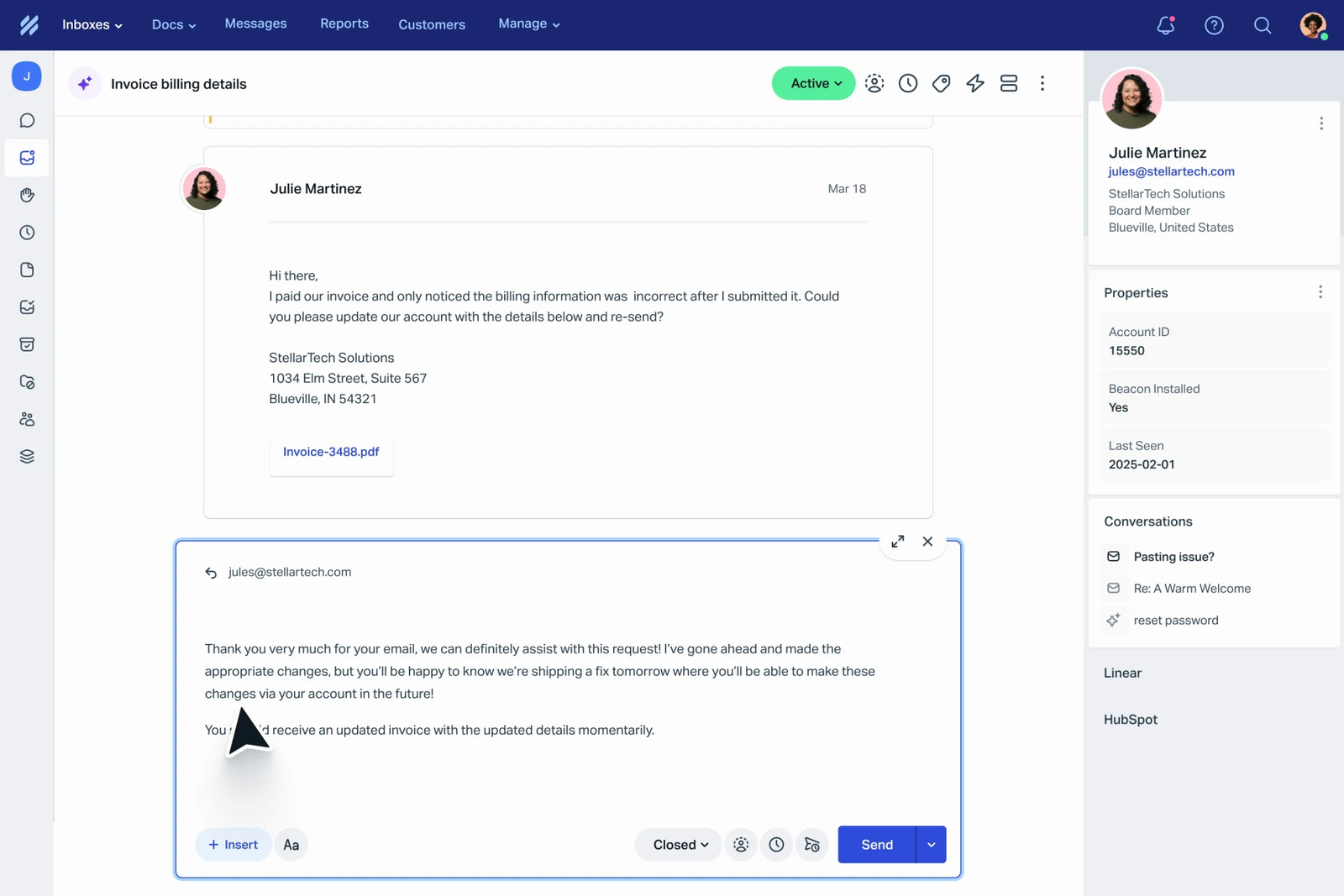
BEST FOR: Teams seeking a “Shared Inbox” style experience along with ticketing capabilities.
KEY DETAILS: Pricing begins at $20 per user, monthly. Docs, Beacon & Workflows are included in pricing.
WHAT IT IS: The opposite of a ticketing system. Not an industrial help desk. It’s one of the easiest ticketing systems for small business tools to use, but each conversation is tracked, labeled & measurable on the back-end.
WHY I LIKE IT: The Collapse Quoted Text function in Help Scout is something I now could not live without. Have you ever seen how many times customers reply with the whole email history? HelpScout automatically collapses this garbage so that you can just view the customer’s new response. When I helped implement this for a non-profit organization with no technical experience, there was one less item on our list to get support questions about on Slack.
RECENT STAT: According to HelpDeskMigration.com’s 2025 report, 68% of agents preferred a conversational experience (ie, HelpScout) compared to using a traditional ticket queue. This equates to better response times & reduced agent burn-out.
| Pros | Cons |
| Clean, non-intimidating UI | No built-in phone support |
| Excellent knowledge base (Docs) | Reporting is less advanced than Freshdesk |
Pro Tip: Use “Workflows” to automatically assign tickets based on keywords. For example: tickets with “refund” go to Sarah; tickets with “login” go to Mike. It takes 5 minutes to set up.
Comparison Table
Here’s a side-by-side comparison of the best ticketing system for small business tools in 2026:
| Ticketing System | Best For | Key Feature | Starting Price | 2027 Outlook |
| Zoho Desk | Zero-budget startups | True free tier for 3 agents | $0 | More AI automation behind a paywall |
| Freshdesk | Growing SMBs | Collision detection + gamification | $15/user/mo | Deeper Freddy AI integration |
| Help Scout | Teams wanting a simple UX | Conversational email interface | $20/user/mo | More proactive reporting features |
How to Choose the Right Ticketing System for Your Small Business
Here is what I believe to be the typical mistake when selecting tools: selecting a product based upon its features rather than its user habits. Consider this. Is your customer support group using Gmail? If so, then Help Scout’s conversational interface will likely feel natural to them. Are you fearful of complex dashboard designs? Zoho’s free tier allows you to try before you buy. The right ticketing system for a small business depends more on how your team works than on features.
Consider these three questions:
- Where are your customers currently reaching you? (only via email? Only via chat? Only via social media?)
- How many people need access to the system? (Most free trials allow for up to 3 users.)
- What is your comfort level with technology? (Are spreadsheets making you uncomfortable? If so, avoid Zoho’s more cumbersome UI.)
Quick picks based upon user type:
- New users: try Zoho Desk free trial. There is no risk.
- Limited budget: Zoho Desk (free), Freshdesk ($15/person).
- User groups that hate software: Help Scout feels like a warm blanket.
- Growing teams: Freshdesk has the most room to grow
Conclusion
Finding an affordable ticketing system for a small business doesn’t have to mean sacrificing sanity or breaking the bank. Start with one tool, even the free one, and just commit to moving every customer conversation into it for one week. You’ll immediately see who’s doing what, where things get stuck, and who your busiest customers are.
Looking ahead to 2027, the real winners will be small teams that use AI to handle the repetitive junk so humans can focus on the conversations that actually matter. Don’t wait for the perfect system. Start messy, then improve.
So here’s my question for you: What’s the one support task that eats up most of your Tuesday mornings? Drop a comment below, I read every one.
Question: Is there some way that I could handle all of my small business’s support requests with email instead of using a ticketing system?
Answer: If your small business receives over twenty (20) support requests each day, you will require a ticketing system. Research indicates that when organizations do not use a ticketing system, response time doubles; however, customer satisfaction is reduced on average by thirty-four percent Super Office, 2025).
Question: Will I be able to transfer to another ticketing platform at a future date and still retain my previous data?
Answer: yes. A number of these platforms provide users with options to export their data in CSV format as well as migrate directly to another service. For example, HelpScout provides users who are migrating from another competitor with free migration services. Likewise, Freshdesk also allows its users to migrate to their service for free.
Question: What Ticketing System for Small Business offers the best free tier in 2026?
Answer: Zoho Desk. As far as we were able to determine, no other free ticketing system offered features like collision detection and service level agreement (SLA) tracking. In fact, Freshdesk does offer a free tier, but it only allows you two (2) agents.
Question: Do I need to use another live chat tool if I have already purchased a ticketing system?
Answer: not any longer. Many ticketing systems (including Freshdesk) now offer live chat capabilities, and they automatically convert those chats into tickets so you do not lose them when the conversation window closes (“the chat hole”).