


I feel like I am already running around with a pair of knives in each hand, emails coming at me fast, Invoices are piling up,p and customers want to know now if they call, email, or send an instant message. And then someone comes along and casually mentions, “You should be using AI.” Helpful? Possibly. Overwhelming? Yes. If you’re a founder, freelancer, or member of a small, lean team, there is no reason to chase after an AI tool for your business.
There is only one reason to look into them. That’s to find tools that can help you not to make you feel fancy. Not to drive you crazy. Just to give you some relief. Let’s take a closer look at how actual people pick and choose AI tools and do it without all the fluff. Without all the noise. Without acting as though everyone has the same needs for their businesses.
Here’s the thing: AI isn’t magic. It’s more like a really fast assistant.
AI will not create an unorganized mess out of your business; that’s your responsibility.
However, AI can assist with the repetitive tasks, the tasks that drain energy but need to be completed nonetheless.
Consider AI as the “help” you would hire on a budget:
- You don’t have to worry about it being absent (calling in sick)
- You never have to pay overtime because it does not complain
- It is excellent at recognizing patterns and repetition
- It needs clear guidance
- Therefore, before looking for tools, take a minute to ask yourself a simple question:
- Where am I wasting my time each week?
The answer to this question is far more important than any feature list.
Let’s be real, what kind of business are you running?
A small independent Etsy seller and an agency that has 15 people working for it live in two completely different worlds. Likewise, the reality of a small local coffee shop is vastly different from the world of a software-as-a-service (SaaS) company.
Instead of asking “What is the best artificial intelligence (AI) tool?” you should be asking yourself, “What problems keep repeating themselves in my business?”
Some common responses to that question might look something like this:
- “I waste so much time responding to e-mails.”
- “Social media marketing takes up way too much of my time.”
- “Accounting causes me a lot of stress.”
- “Customers repeatedly have the same questions.”
The repeated complaints can lead you directly to a variety of categories of AI tools for small businesses without needing to make any guesses.
The main types of AI Tool for Your Business actually use
Not every tool fits every business, but patterns show up fast when choosing an AI tool for your business
Content and writing help (when words feel heavy)
If writing blogs, emails, or product descriptions is too overwhelming for you and creates an inability to write (or a “freeze”), then there are AI writing tools to help get you unstuck from this “freeze” of paralysis.
OpenAI’s ChatGPT works well as a “first-draft-buddy”. Not perfect and not psychic, but fast. You will still be adding your own voice, your stories, and your judgment into your writing. Good fit if:
- Your marketing has been too slow
- You have trouble getting words onto paper (or the screen) in front of you
- You need ideas more than a final copy

Design tools (for people who say “I’m not creative”)
Design now means using tools (such as Canva) that can take care of layout, size, and overall design visual balance for you; also, they provide some basic AI design ideas that will give you a good starting point for your design without an art degree.
Good fit for:
- Your social media posts appear to be developed quickly
- Your branding appears to be uncoordinated
- You want to create quick visual content.
Customer support and chat tools (answer once, not fifty times)
Customers ask many of the same types of questions.
- How long will my order take to ship?
- What are your refund policies?
- What does this product include?
AI chat solutions can answer some of these basic questions, so you can use your time for the more important conversations.
This is where CRM-connected AI chat solutions (like ) come in handy.
Good fit if:
- Your inbox never stops filling up
- You repeat the same FAQs every day
- Support has taken a back seat to growth

Finance and admin helpers (the unglamorous stuff)
Accounting tasks are important, but no one loves to do them!
QuickBooks is an AI-based accounting platform that reduces manual entry for accounts payable, identifies strange numbers, and keeps your books organized.
Good fit for you if:
- Your invoices are piling up
- Your expenses get jumbled
- You want to reduce your number of spreadsheet headaches.
Workflow and Automation Tools (Connecting the Dots)
Some tools shine on their own, while others shine in conjunction with other tools.
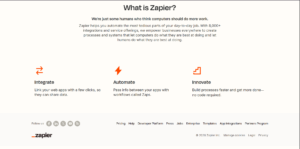
Zapier is a workflow automation tool that allows you to create an integration between multiple applications to flow data automatically behind the scenes. Less copy and paste. Fewer “did I already do this?” moments.
Good fit for you if:
- You are using many applications
- Tasks are repeating themselves between applications
- Manual steps lead to errors
When selecting an AI tool for your business, features matter far less than whether the tool actually fits your workflow and daily operations.
The majority of business owners buy software in the same manner as they purchase gym memberships- they are initially enthusiastic about their new membership, but after a few weeks, they quietly stop going to the gym.
Don’t be one of those.
When evaluating AI tools for your small business, there are three human questions you should ask yourself when evaluating an AI tool:
1. Does this tool reduce stress or add to it?
If setting up the tool seems overwhelming or if the dashboard is too much to handle, the tool will likely be forgotten.
2. Can I use it without training sessions?
There’s no reason to require tutorials that resemble college lectures.
A good tool either explains itself or provides a middle ground.
3. Will this grow with me or trip me later?
Many tools provide adequate support during the beginning stages of implementation, but fail once the demand increases.
Always review pricing tiers and limitations before making a final decision. Surprise can be painful.
Pricing talk because budgets matter
When choosing an AI tool for your business, free plans may look attractive, but it is important to evaluate the real value the tool provides. They can be. But sometimes they’re only a lure.
Consider the value of free plans differently:
- How many hours will using this tool save you per month?
- What is that time worth to you?
- Will this tool replace a process you hate doing?
If a $30 monthly tool provides 3 hours of savings, this is likely a great buy even if your team is quite small.
Don’t ignore trust and data safety.
All AI-based tools deal with confidential information such as emails, customer information, etc., and payment information.
Before investing:
- Just skim through privacy terms (you don’t have to read every single word)
- Find out where the data resides
- Find legitimate reviews (not just testimonials)
- Follow your instincts. If something feels fishy, it probably is.
A quick reality check: AI won’t replace judgment
This matters. AI may be able to offer suggestions. AI can also summarize content and work at a faster pace than you. However, AI will never be able to fully grasp your customer base, values, or long-term goals. Smart organizations view AI as a second brain, not the boss. You maintain control of your organization.
Conclusion
If you are still unsure which AI tool for your business is the right fit, start simple.
Honestly, the simplest route is to do the following:
- Select one pain point
- Select an AI solution that solves the selected pain point
- Use the AI solution daily for 2 weeks
- Quit using it if you choose to do so; no feelings of regret
- Momentum beats out the perfect plan.
If your business relies on multiple apps, workflow automation can save a lot of time. You can also explore our guide on the best process automation software for businesses to understand how automation tools connect different applications.